


Europe’s Least Stressful Countries for Beginner Drivers
Learning to drive is one of the biggest confidence tests many people face. For beginners, the pressure is not just about handling the car itself, but also coping with traffic, road conditions, unfamiliar rules, and the behaviour of other drivers. In some countries, that learning curve is made much easier by calmer roads, safer networks, and better-maintained infrastructure.
Our European motorway specialists at CzechVignette.cz have released a ranking of the least stressful European countries for beginner drivers. The study analysed four key metrics, including traffic congestion levels, road deaths, road quality, and registered vehicles per 1,000 residents, to calculate an overall Road Stress Score, with Sweden claiming the top spot.
These results are designed to help readers compare the best European countries for beginner drivers and understand which are rated highly in the study.
Top 10 least stressful European countries for beginner drivers
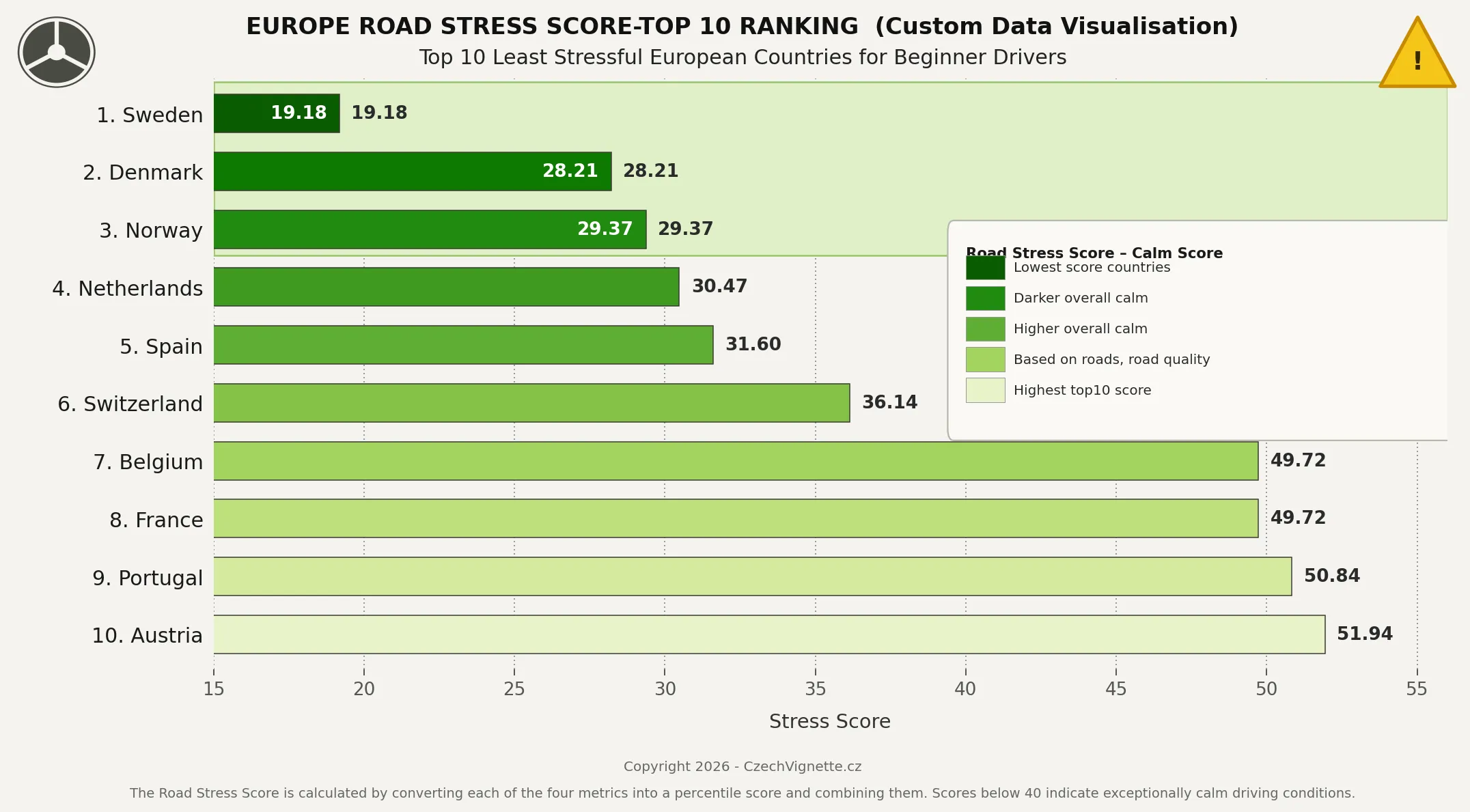
| Rank | EU country | Congestion | Road deaths /M | Road quality (1–7) | Vehicles /1k | Stress score |
|---|---|---|---|---|---|---|
| 1 | Sweden | 32.96 | 20 | 5.3 | 470 | 19.18 |
| 2 | Denmark | 41.13 | 24 | 5.6 | 478 | 28.21 |
| 3 | Norway | 29.85 | 16 | 4.5 | 517 | 29.37 |
| 4 | Netherlands | 36.64 | 38 | 6.4 | 513 | 30.47 |
| 5 | Spain | 31.3 | 36 | 5.7 | 544 | 31.60 |
| 6 | Switzerland | 43.27 | 28 | 6.3 | 542 | 36.14 |
| 7 | Belgium | 34.45 | 40 | 4.4 | 513 | 49.72 |
| 7 | France | 35.28 | 48 | 5.4 | 579 | 49.72 |
| 9 | Portugal | 35.45 | 60 | 6 | 571 | 50.84 |
| 10 | Austria | 45.4 | 38 | 6 | 569 | 51.94 |
Full table and methodology below.
- Sweden ranks as the least stressful European country for beginner drivers, with a Road Stress Score of 19.18. The country records just 20 road deaths per million residents, the second-lowest figure in the study, making it one of the safest places in Europe for new drivers to build confidence. Its road quality score of 5.3/7 also suggests a well-maintained network, while a congestion level of just 32.96 means beginners are less likely to face constant stop-start traffic, aggressive merging, or crowded urban pressure from the start.
- Denmark follows in second place with a Road Stress Score of 28.21. Its roads score 5.6/7 for quality, one of the strongest figures in the top 10, while its road death rate of 24 per million residents remains among the lowest in the ranking. Although Denmark’s congestion level is higher than Sweden’s and Norway’s, its combination of safe roads, reliable surfaces, and modest vehicle density makes it a reassuring environment for drivers still gaining experience.
- Norway ranks third, helped by the lowest road death rate in the entire study at just 16 per million residents. It also records the lowest congestion level at 29.85, meaning beginner drivers are less likely to be overwhelmed by heavy traffic or constant lane pressure. While its road quality score of 4.5/7 is lower than several other countries in the ranking, Norway’s strong safety record and quieter road conditions keep it firmly among Europe’s least stressful places to learn and drive.
- The Netherlands places fourth with a Road Stress Score of 30.47. Its standout strength is road quality, scoring 6.4/7, the highest of any country in the study. For beginner drivers, reliable road surfaces can make a real difference, reducing the need to react suddenly to potholes, broken asphalt, or unpredictable surface changes. With moderate congestion and vehicle density, the Netherlands offers a relatively stable driving environment, particularly for those still developing road confidence.
- Spain completes the top five with a Road Stress Score of 31.60. Its congestion level of 31.3 is the lowest in the study, while its road quality score of 5.7/7 suggests that drivers benefit from generally strong infrastructure. Although Spain has a higher number of registered vehicles per 1,000 people than Sweden, Denmark, and Norway, its lower congestion levels and solid safety performance help make it one of the more forgiving countries for beginner drivers.
Expert comment

“Sweden topping this ranking shows just how much calmer road conditions can help someone who is still building confidence behind the wheel. New drivers need more than good lessons. They need roads that give them room to think, react, and learn without feeling rushed or overwhelmed. That is what Sweden does well. Its roads are generally well maintained, traffic is lighter than in many other European countries, and its safety record is very strong, so beginners are not immediately dealing with the same level of pressure they might face elsewhere.”
“The real challenge often comes when those conditions change. A beginner may feel comfortable on calm, predictable roads, then suddenly find themselves driving somewhere with heavier traffic, rougher surfaces, different enforcement systems, or more aggressive motorway behaviour. National rankings are useful, but they should not replace preparation. Anyone planning to drive abroad, especially newer drivers, should take time to understand what changes once they cross the border.”
— Mattijs Wijnmalen, CEO, CzechVignette.cz
What does this mean for beginner drivers in the Czech Republic?
A lower position in a ranking of the least stressful countries to drive in should not be read as a warning against driving in the Czech Republic. In this study, the country’s result is mainly linked to pressure on the road network, especially congestion and higher demand on key routes, rather than a simple judgement on whether people should drive there.
For beginner drivers, this means preparation matters. Newer drivers may need to allow more time for busy journeys, plan routes carefully, and get familiar with local rules, motorway requirements, and road signs before setting off. The roads can still be manageable with the right preparation, but drivers should expect some busier conditions, particularly around major towns, commuter routes, and popular travel periods.
Anyone planning to drive there can read our full guide to driving in the Czech Republic.
Methodology
This study identifies the least stressful European countries for beginner drivers by analysing four key metrics: traffic congestion levels, road deaths per million residents, road quality, and registered vehicles per 1,000 people. Data was gathered from the TomTom Traffic Index, the ETSC 2025 PIN report, the World Economic Forum, Eurostat, and World Population Review. To determine the final rankings, each metric was converted into a percentile score, which was then used to calculate the overall stress level for each country.
Full results: all 28 countries
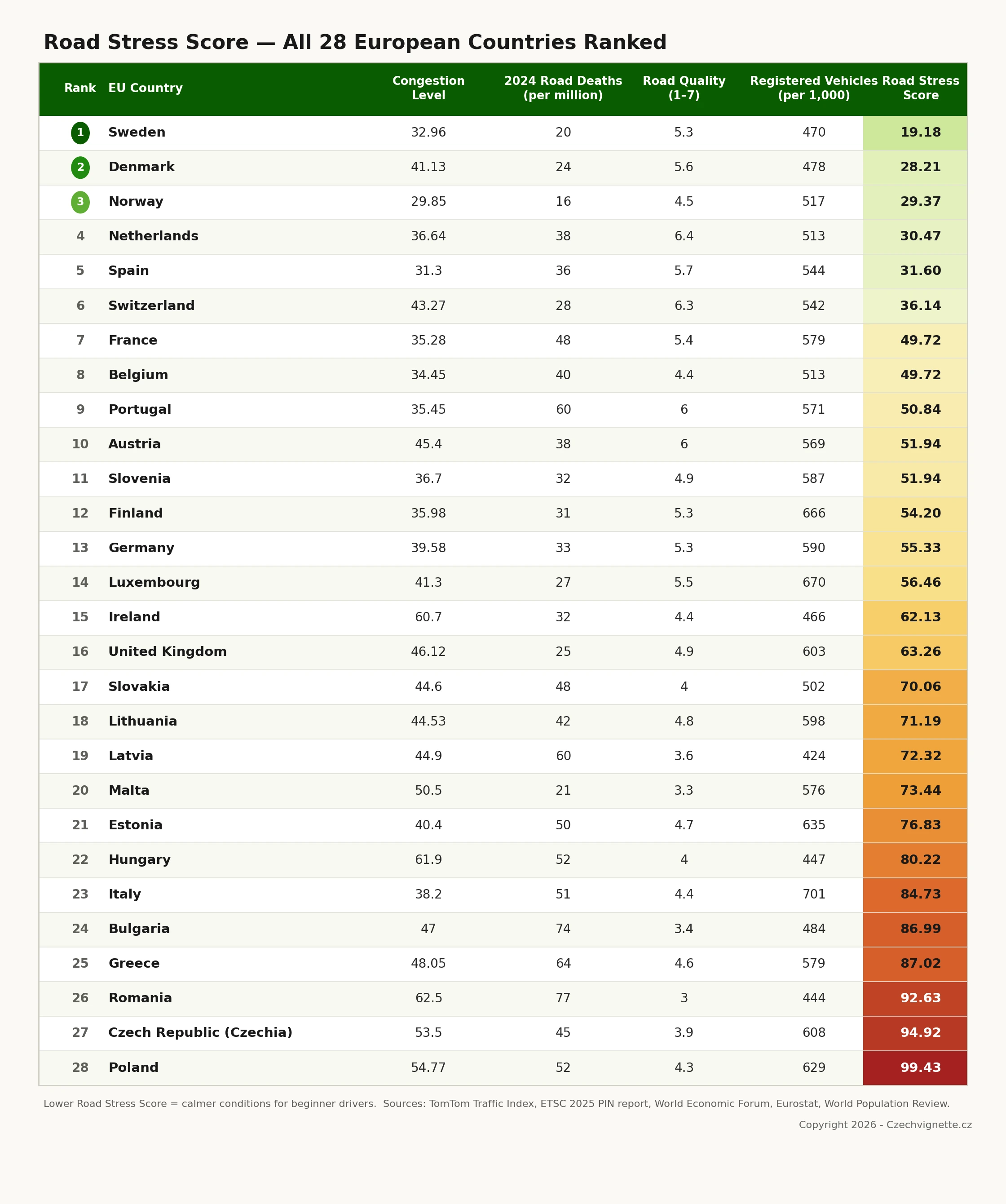
| Rank | Country | Congestion | Road deaths /M | Road quality (1–7) | Vehicles /1k | Stress score |
|---|---|---|---|---|---|---|
| 1 | Sweden | 32.96 | 20 | 5.3 | 470 | 19.18 |
| 2 | Denmark | 41.13 | 24 | 5.6 | 478 | 28.21 |
| 3 | Norway | 29.85 | 16 | 4.5 | 517 | 29.37 |
| 4 | Netherlands | 36.64 | 38 | 6.4 | 513 | 30.47 |
| 5 | Spain | 31.3 | 36 | 5.7 | 544 | 31.60 |
| 6 | Switzerland | 43.27 | 28 | 6.3 | 542 | 36.14 |
| 7 | France | 35.28 | 48 | 5.4 | 579 | 49.72 |
| 8 | Belgium | 34.45 | 40 | 4.4 | 513 | 49.72 |
| 9 | Portugal | 35.45 | 60 | 6 | 571 | 50.84 |
| 10 | Austria | 45.4 | 38 | 6 | 569 | 51.94 |
| 11 | Slovenia | 36.7 | 32 | 4.9 | 587 | 51.94 |
| 12 | Finland | 35.98 | 31 | 5.3 | 666 | 54.20 |
| 13 | Germany | 39.58 | 33 | 5.3 | 590 | 55.33 |
| 14 | Luxembourg | 41.3 | 27 | 5.5 | 670 | 56.46 |
| 15 | Ireland | 60.7 | 32 | 4.4 | 466 | 62.13 |
| 16 | United Kingdom | 46.12 | 25 | 4.9 | 603 | 63.26 |
| 17 | Slovakia | 44.6 | 48 | 4 | 502 | 70.06 |
| 18 | Lithuania | 44.53 | 42 | 4.8 | 598 | 71.19 |
| 19 | Latvia | 44.9 | 60 | 3.6 | 424 | 72.32 |
| 20 | Malta | 50.5 | 21 | 3.3 | 576 | 73.44 |
| 21 | Estonia | 40.4 | 50 | 4.7 | 635 | 76.83 |
| 22 | Hungary | 61.9 | 52 | 4 | 447 | 80.22 |
| 23 | Italy | 38.2 | 51 | 4.4 | 701 | 84.73 |
| 24 | Bulgaria | 47 | 74 | 3.4 | 484 | 86.99 |
| 25 | Greece | 48.05 | 64 | 4.6 | 579 | 87.02 |
| 26 | Romania | 62.5 | 77 | 3 | 444 | 92.63 |
| 27 | Czech Republic (Czechia) | 53.5 | 45 | 3.9 | 608 | 94.92 |
| 28 | Poland | 54.77 | 52 | 4.3 | 629 | 99.43 |
Rankings reflect the study methodology at time of publication. Primary sources: TomTom Traffic Index, ETSC PIN, WEF, Eurostat, World Population Review.