

Intro
Driving in the Czech Republic comes with a clear set of rules, and some of them are stricter than many visitors expect. From the documents you must carry to mandatory vehicle equipment in your car, there are a few non-negotiables you need to get right before you cross the border.
This guide breaks down everything you need to know: what to bring, which road rules tend to catch drivers out (including the strict zero alcohol limit and condition-based winter tyre law), and whether your vehicle needs a Czech motorway vignette. It applies to passenger cars under 3.5 tonnes.
Before our team drove from Vienna to Prague via the D1 in February 2026, we stopped at a service station just inside the Czech border to double-check everything — documents, equipment, the works. It turned out to be time well spent.
About an hour later, we ran into a roadside police check, and having everything in order made the stop quick and uneventful.
Everything in this guide is based on what we have seen first-hand on Czech roads and border crossings, updated for 2026.

Before you cross the border — 5 things you must have
At a glance: the non-negotiables
- ✔ A valid driving licence
- ✔ Your vehicle registration document (V5C for UK drivers)
- ✔ Proof of insurance (a Green Card is strongly recommended)
- ✔ A warning triangle, reflective jacket, and first aid kit
- ✔ A valid Czech e-vignette (if you plan to use motorways or expressways)
⚠️ These are not "nice to have" items. They are the basics Czech police will expect you to produce during a roadside stop.
Documents You Must Carry When Driving in the Czech Republic
Czech law requires drivers to carry specific documents at all times and present them on request. While checks are selective rather than constant, they are common on major routes and near border crossings.
Our team observed this directly near the Petrovice–Breitenau border crossing on the D8/A17 route, where vehicles were being pulled over and passports examined alongside standard driving documents.
It is also worth noting that German federal police currently carry out border controls on the German side of this crossing, which can lead to significant delays in both directions.
During our February 2026 trip, our photographer captured the queuing and checkpoint infrastructure at Petrovice–Breitenau.

What you need
- Valid driving licence — A full licence is required (minimum age 18). UK photocard licences are accepted; no International Driving Permit needed.
- Passport or national ID — EU/EEA nationals can use an ID card; UK nationals must carry a passport.
- Vehicle registration document — V5C for UK drivers. If using a hire or company car, carry a hire agreement or authorisation letter.
- Proof of insurance — Must cover Czech Republic. A Green Card is not mandatory but strongly recommended.
- ETIAS authorisation — Not launched as of April 2026. Will be required for non-EU nationals once introduced.
Documents checklist
- ✔ Valid driving licence
- ✔ Passport / national ID
- ✔ Vehicle registration document (V5C / hire agreement)
- ✔ Insurance proof / Green Card
- ✔ ETIAS authorisation (check launch date at etias.eu )
- ✔ Czech e-vignette (if using motorways or expressways)
Mandatory Vehicle Equipment: What You Must Have in the Car
Czech law — specifically Decree No. 341/2014 Coll. and Act No. 361/2000 Coll. — sets out specific equipment requirements for all motor vehicles using Czech roads.
These rules apply equally to foreign-registered vehicles.
| Equipment | Required? | Notes |
|---|---|---|
| Warning triangle | Yes | Place 50m behind the vehicle (100m on motorways). |
| Reflective jacket | Yes | Keep it in the cabin, not the boot. |
| First aid kit | Yes | DIN 13164 compliant and easily accessible. |
| Spare bulbs & fuses | Yes | Not required for LED/xenon systems. |
| Headlamp deflectors | UK/IE only | Required for right-hand-drive vehicles. |
| Fire extinguisher | No | Recommended for longer trips. |
| Spare wheel / repair kit | Depends | Required if no run-flat tyres. |
⚠️ First aid kit placement: Must be kept inside the cabin and be immediately accessible — not buried under luggage in the boot. Czech police do check this.
ℹ️ Reflective jacket: Same rule applies — keep it in the cabin, not the boot.
🇬🇧 UK & Irish drivers: Headlamp deflectors are required and widely available.
👶 Travelling with children? Any child under 150 cm or 36 kg must use an approved child seat.
Czech Road Rules: Speed, Alcohol & Winter Tyres
Speed limits in the Czech Republic are strictly enforced and regularly monitored by automated systems and roadside checks.
| Road type | Passenger cars |
|---|---|
| Built-up areas | 50 km/h |
| Single carriageways | 90 km/h |
| Expressways | 110 km/h |
| Motorways | 130 km/h |
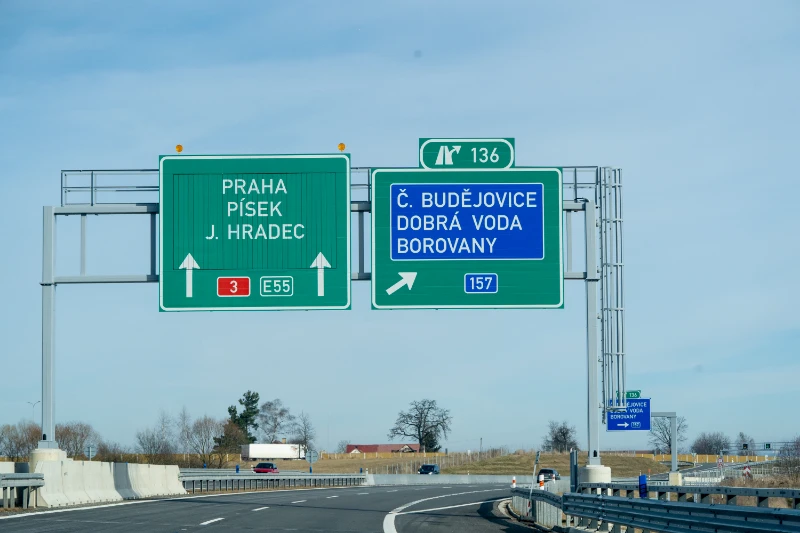
During our 20 February 2026 journey from Prague toward Dresden, we observed active enforcement gantries along the D8 and D1 corridors.
150 km/h pilot scheme — D3 motorway (active since October 2025)
A 47-kilometre section between Planá nad Lužnicí and Úsilné operates with variable limits up to 150 km/h only when electronic signs allow it.
Czech Ministry of TransportAlcohol: zero tolerance
Winter tyres
Requirement is condition-based, not date-based. Minimum tread depth: 4 mm.
Headlights
Dipped headlights mandatory 24/7.
Mobile phones
Handheld use banned.
Emergency corridor
Mandatory on multi-lane roads.
Radar detectors
Strictly prohibited.
Does My Vehicle Need a Czech Motorway Vignette?
Passenger cars under 3.5t require an e-vignette for motorways and expressways.
| Duration | Price |
|---|---|
| 10-day | CZK 310 |
| 30-day | CZK 480 |
| Annual | CZK 2570 |
FAQ
What documents do I need to drive in the Czech Republic?
You will need a valid driving licence, passport or national ID, vehicle registration document (V5C for UK drivers), and proof of insurance. A Green Card is strongly recommended. UK nationals will also require ETIAS authorisation once launched.
What mandatory equipment must I carry in the Czech Republic?
A warning triangle, reflective jacket, and first aid kit compliant with DIN 13164 are required by law. UK and Irish drivers must also use headlamp beam deflectors.
What is the drink-drive limit in the Czech Republic?
Zero — 0.0% BAC. No alcohol whatsoever is permitted while driving.
Are winter tyres compulsory in the Czech Republic?
Yes, whenever wintry conditions are present on the road. The rule is condition-based, not date-based.
What is ETIAS and do I need it for the Czech Republic?
ETIAS is the EU travel authorisation system for non-EU nationals visiting the Schengen Area. UK, US, and other non-Schengen passport holders will need it once it becomes active.
Do I need a UK sticker to drive in the Czech Republic?
If your number plate includes the UK identifier with the Union Flag, no sticker is needed. Otherwise, you must display a UK sticker on the rear of the vehicle.
What side of the road do they drive on in the Czech Republic?
On the right-hand side.
Is it safe to drive in the Czech Republic?
Generally yes. Motorways are well-maintained and clearly signposted. Rural roads may vary in quality outside main corridors.
What is the emergency number in the Czech Republic?
112 is the pan-European emergency number and works throughout the country.
Can I drive a hire car in the Czech Republic?
Yes, provided you meet rental requirements. Minimum age is usually 21, and companies typically require at least one year of driving experience plus a credit card deposit.
Written by: Mattijs Wijnmalen, CEO and co-founder of CzechVignette.cz. Over 10 years of experience in European road tolling. Research based on field trips in February and March 2026 along D1, D8/A17 and Prague–Dresden routes.
Fact-checked by: Freek Jurg, COO and co-founder of CzechVignette.cz.